|
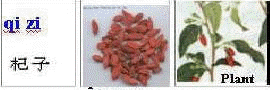
gou qi zi (fruit)
枸杞子
di gu pi (bark of the plant)
地骨皮
gou qi ye (leaves of the plant)
枸杞葉
Translated and edited
by: Joe
Hing Kwok Chu
|
Pharmaceutical
name:
英文藥名 |
Fructus Lycii |
|
Latin
botanical name:
拉丁文學名 |
Lycium barbarum L.or
L chinense Mill |
|
Pron. in Japanese:
日語發音﹕ |
kukoshi |
|
Pron. in Korean:
韓語發音﹕ |
kugicha |
|
Pron. in Cantonese:
粵音﹕ |
gau gei zi |
|
Common Name﹕
英文名稱: |
Chinese wolfberry fruit, lycium fruit |
|
Distribution﹕
產地: |
Ninxia, Gansu, Qinghai, Tibet, Inner Mongolia (L.
barbarum), Hebei (L. chinense)
寧夏﹐甘肅﹐青海﹐西藏﹐內蒙﹐河北。 |
|
Properties
(characteristics)﹕
性味﹕ |
sweet, neutral
甜﹐ 平。 |
|
Channels
(meridians) entered:
歸經﹕ |
liver, lung, kidney
肝﹐肺﹐腎。 |
|
Actions &
Indications: |
nourishes and tonifies the liver and kidney;
alleviates sore back, leg, and stomach; improves night vision, blurred
vision,
diabetes, premature white hair and consumption. The leaves and bark can be used for hot flashes and
cough due to consumption. The leaves can be used for tonifying
deficiency and to get rid of anxiety, pain in joints and skin, and the toxin
from boils. |
|
Medical Function﹕
藥理: |
Medical Function﹕
-
improves and regulates immune system.
-
anti-aging properties : a study on 43 healthy senior adults in
which each ate 50 grams of qi zi continuously for 10 days (as a therapy
period). The blood tests showed that immune indicators IgA, IgG and lymph
cell conversion rate were elevated, cAMP increased, cGMP decreased. The
ratios of cAMP/cGMP were elevated to healthy levels. Testosterone were
elevated.
-
lowers blood lipids,
-
elevate level of
testosterone
-
protects liver function,
prevents fatty liver
-
contains anti-cancer properties
-
simulates estrogens
-
improves white blood cell counts
during chemotherapy
-
fruit, stems and leaves
can
lowers blood sugar
-
fruit, stems and leaves can lower blood pressure
-
anti-oxidant
-
taking gou qi zi can
increase the weight of the uteri of mature and immature mice.
-
enhance memory
-
toxicity is minimal
藥理:
- 對機體免疫功能的作用
﹕能顯著提高吞噬細胞的吞噬百分率和吞噬指數,還可提高因放射療法或惡性腫瘤所導致的免疫功能下降的患者的淋巴細胞轉化率,和吞噬細胞的吞噬率,以提高患者的免疫能力。
- 抗衰老之作用 ﹕曾實驗四十三例無明顯疾病的志願老人,每日嚼服50g,連續十天為一療程,療程結束後抽血檢查,免疫功能指標可見IgA﹐IgG
和淋巴細胞轉換率明顯提高,反應有向年輕化逆轉的傾向。
-
降血脂
- 促進高睪丸酮之分泌,起著強壯的作用。
- 對肝臟的保護作用﹕枸杞水浸液對四氯化碳引起的肝損害,有輕微的抑制脂肪在肝細胞內沈積,和促進肝細胞新生的作用。
- 抗癌作用
- 促進雌激素之分泌。
- 對造血系統的影響 ﹕枸杞可促進造血機能恢復,臨床可以考慮與化療藥物合用,預防和緩解白細胞減少症。
- 枸杞
葉與枸杞子都有降血糖作用
-
枸杞
葉與枸杞子都有降血壓作用
- 對子宮的作用 ﹕枸杞子對未成熟或成熟的小鼠,均有明顯的促進子宮增重的作用。
- 抗氧化作用
- 增強記憶力
- 毒性小
|
|
Chemical
ingredients﹕
化學成份: |
carotene, lutein, thiamine, riboflavine, nicotinic acid,
ascoric acid, beta-sitosterol, linoleic acid, zeaxanthin, betaine,
physalien, cryptoxanthin, atropine, hyoscyamine, scopoletin, trace
minerals ,
leucine、isoleucine、valine、proline、alanine、tyrosine、lysine、glycine、glutamic
acid、aspartic acid、phenylalanine、hydroxyglutamic acid、serine、arginine.
Leaves also contain rutin. |
|
Dosage﹕
用量: |
root, bark and fruit: 6 to 15 g per day.
leaves are used as a vegetable.
根﹐皮﹐子﹕6 ~ 15 克。葉作蔬菜用。
|
|
Samples of formulae: |
For spermatorrhea: gou qi zi 6 g,
wu wei zi 2 g,
rou cong rong 2 g, ren sheng 2 g,
fu ling 3 g, shu di huang 3 g,
da zao 3
g, sheng jiang 2 g, gan cao 2 g. Cook in 600 cc of water and simmer to 300
cc. Make into 3 servings per day. (source He Han Yao Yin Yong Fang)
For improving sperm count and
sperm activity: wu zi yan zong wan
(五子衍宗丸)
For premature white hair:
gou qi zi 15 g, rice 30 g. Make into porridge. Use daily. (folk formula) |
|
Modern
Research: |
to be loaded |
|
Caution:
禁忌﹕ |
Not to use in cases external heat, (like
swelling with inflammation), spleen deficient (pixu) with dampness and loose
stool or diarrhea.
外部實熱、脾
虛 濕滯及腸滑便溏者忌服。 |
|
Quality:
品質鑒別﹕ |
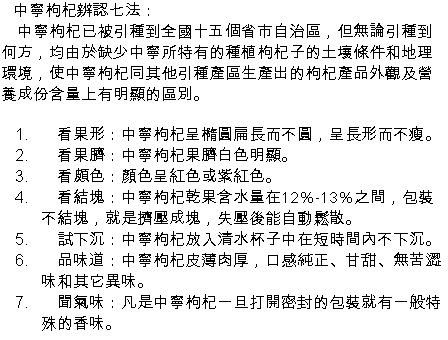
The better quality qi zi is
from Zhong Ning Area.
Quality identification:
-
Shape: oblong--not
round--but not thin.
-
Color: red or purplish
red except for petals.
-
Petal area: obviously
white. If artificial color has been added, the areas where the petals
are will be tinted. Artificial coloring is a sign that the seed is of
lower quality. Artificial coloring can be toxic.
-
Dryness: the water
content should be about 12% to 13%. The seeds should not lump together.
Test for dryness by squeezing them together and then releasing
pressure. Good quality seeds should not lump together; they should
become loose when the pressure is released.
-
Taste: sweet. The seeds
should not taste acrid.
-
Smell: the smell is
fragrant once the package is opened.
-
Sinking test: When
dropped into water, the seeds should float for sometimes and should
not sink in a short time.
National Quality Inspection
Agency of China has banned the use of sulfur dioxide to preserve the fruit.
资料来源:摘自“美食導報”2002、11、15
國 家 質 檢
總 局 嚴 禁 用 硫 磺 加 工 。
看關於二氧化硫處理過的乾貨。 |
Lutein and zeaxanthin help protect
the eyes from damaging sunrays. As people get older, these
carotenoids decline in the eyes, and may cause macular degeneration.
Note:
Gou qi leaves are usually sold in Chinese grocery market as vegetable.
Usually the fresh leaves can be used as soup vegetable.
More info in Chinese:
http://www.ohayoo.com.tw/%E6%9E%B8%E6%9D%9E%E4%B9%8B%E7%9F%A5%E8%AD%98(%E5%86%8D%E7%BA%8C).htm
|